Building a Practical Water-Emergency Plan for Schools and Learning Centers
A single burst pipe can shut down a school building faster than almost any other type of infrastructure failure. Facilities management researchers have documented cases such as a sprinkler line rupture at Umatilla High School in Oregon, where flooding spread across multiple classrooms and administrative offices during a winter break, disrupting operations right up until students were due back on campus, according to ASIS International. Incidents like this show how quickly a plumbing failure, a storm, or a hidden leak can turn into a full building closure.
Schools face a wider range of water risks than most commercial buildings because of their density of occupants, sensitive equipment, and tight academic calendars, as noted by water restoration specialists who work with educational facilities. Burst pipes, aging roofs, sudden storms, and sewage backups are among the most common triggers, and each one carries its own safety and cleanup demands. When a serious incident overwhelms in-house maintenance staff, many districts turn to specialized services such as water damage restoration in Atlanta to handle structural drying, contamination control, and rapid reopening. Having a plan in place before an emergency happens, rather than scrambling afterward, is what separates a short disruption from a multi-week closure.
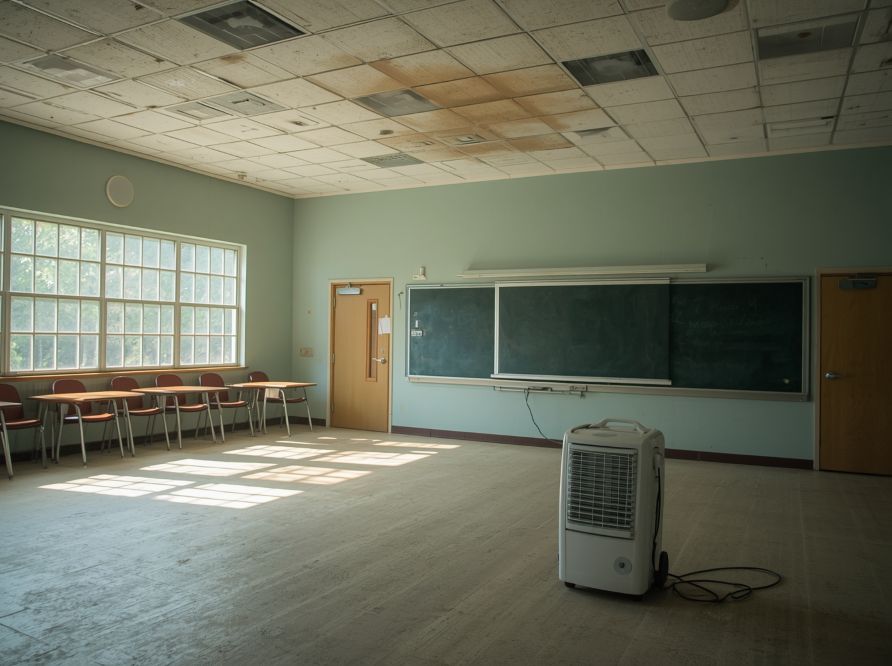
Common Sources of Water Damage in Schools
Understanding where water problems typically originate helps administrators prioritize inspections and staff training. Insurance risk consultants who work with school districts point to plumbing failures as one of the most frequent and costly categories, particularly frozen pipes that burst and release large volumes of water into occupied spaces, according to AssuredPartners. Beyond plumbing, four other sources show up repeatedly in facility incident reports.
- Roof leaks caused by aging membranes, storm damage, or clogged drainage systems
- Severe weather events, including heavy rain and localized flooding around building foundations
- Sewage backups, which introduce contamination risks on top of standard water damage
- Hidden moisture in wall cavities, ceiling tiles, or crawl spaces that goes unnoticed until mold develops
Step 1: Build an Evacuation and Safety Protocol
The first minutes of a water emergency should follow a rehearsed routine rather than an improvised one. Facility guidance for commercial buildings recommends shutting off the water supply immediately if it is safe to do so, then cutting power to any area where water has reached outlets or electrical fixtures, according to industry recommendations compiled by Envigilance. Staff should know the exact location of main shutoff valves, and those locations should be posted clearly in maintenance areas and shared during staff training. If the water source is contaminated, such as in a sewage backup, the affected area should be evacuated entirely rather than approached for cleanup.
Step 2: Protect Student and Administrative Records
Paper records, transcripts, and administrative files are often stored in ground-floor offices, which puts them directly in the path of rising water or roof leaks above. Restoration guidance developed alongside the EPA’s mold prevention framework recommends photocopying or digitizing valuable documents in advance and, for items already wet, freezing them in a frost-free freezer to halt deterioration until they can be professionally dried, based on the U.S. Environmental Protection Agency’s Mold Remediation in Schools and Commercial Buildings guidance. Schools that keep digital backups of enrollment records, health forms, and IEP documentation reduce the risk of losing irreplaceable information during a flooding event.
Step 3: Communicate Clearly With Parents and Staff
A water emergency during school hours affects far more people than the building itself. Families need timely, accurate information about whether classes are cancelled, where students should be picked up, and when normal operations will resume. A short initial message acknowledging the incident, followed by regular updates as the situation develops, helps prevent rumors and confusion. Districts that have a pre-drafted communication template, covering evacuation notices, closure announcements, and reopening confirmations, are able to notify families within minutes rather than hours.
Step 4: Assess Moisture Before Reopening
Visible water is only part of the problem. Moisture trapped inside walls, under flooring, or above ceiling tiles can fuel mold growth well after the initial spill appears to be cleaned up. The EPA’s guidance for schools and commercial buildings states that mold will generally begin colonizing wet building materials within 24 to 48 hours, which makes fast, thorough drying the single most important factor in preventing a secondary mold problem. Porous materials such as ceiling tiles, carpet padding, and insulation that stay wet beyond that window typically need to be removed and replaced rather than dried in place, per the same EPA framework.
Moisture meters and infrared inspection are commonly used by restoration crews to confirm that wall cavities and subflooring have actually reached a safe moisture level before rooms are reopened. Lingering dampness does not just invite mold, it can also draw insects and rodents into a building, and some districts have turned that reality into a teaching moment by pairing pest inspections with lessons on urban ecosystems, an approach made easier when schools have access to affordable pest removal in Buffalo.
Step 5: Coordinate a Safe Reopening
Reopening a building after a significant water event involves more than mopping up standing water. A phased approach works best: confirm that electrical systems have been inspected and cleared, verify that air quality and humidity levels fall within a safe range, and document the condition of every affected room with photographs for insurance purposes. Commercial water damage specialists note that engaging professional support to notify insurers and manage the claims process early in the response can shorten the overall recovery timeline, according to GHP. For extensive plumbing failures, some districts also discover the need for a broader systemic repair, since a single burst pipe can reveal aging infrastructure that requires attention beyond the immediate incident.
Looking Ahead
Water emergencies in schools are rarely entirely preventable, but their impact on learning time and building integrity is largely determined by how quickly staff respond and how well the response is coordinated in advance. Districts that invest in leak detection sensors, automatic shutoff valves, and clear staff protocols tend to catch problems earlier and limit the scope of damage. Pairing that prevention work with a documented plan for evacuation, records protection, family communication, and professional restoration support gives schools a realistic path back to normal operations after even a serious incident.
